
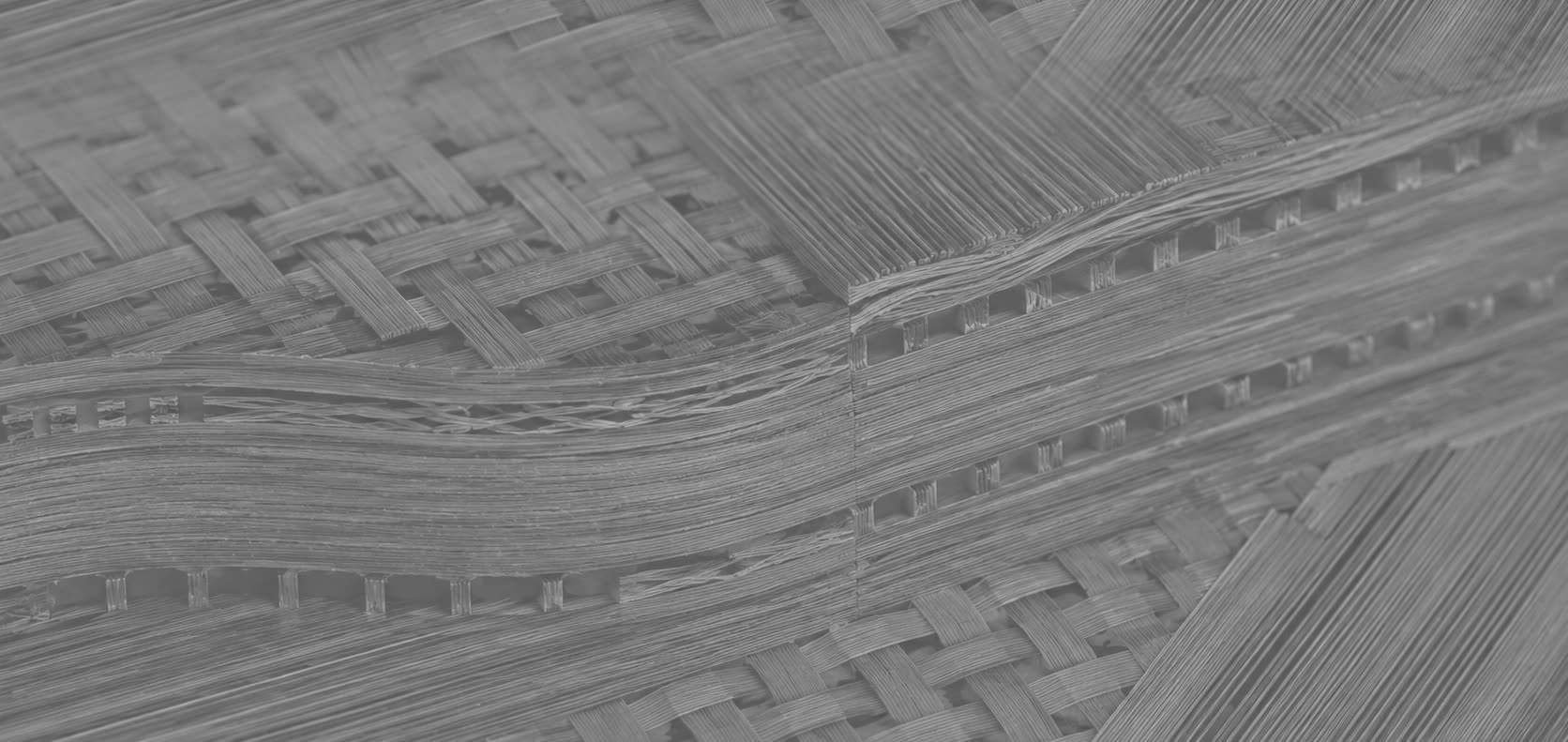
Some of the most advanced materials in the world look unremarkable. They are often gray or brown, porous, or fibrous. What makes them advanced is not how they look or that they are made from exotic atoms, it is that enormous amounts of engineering have gone into making them behave in a very particular way. Modern engineering problems rarely ask for a material to optimize one property in isolation; a battery needs to store energy, survive thousands of cycles, resist mechanical damage, and still be manufacturable at scale. The foam in a seat cushion needs to be comfortable yet provide support, resilient over years of use, light, flame resistant, and inexpensive. A rocket nozzle needs to carry enormous structural loads while centimeters away from propellant gases hot enough to instantly melt most other materials.
These are systems of constraints, and the materials that satisfy them are themselves systems. Their behavior is determined not just by what they are made of, but by how their constituents are arranged, processed, and ultimately used. This is what we mean when we talk about an advanced material.
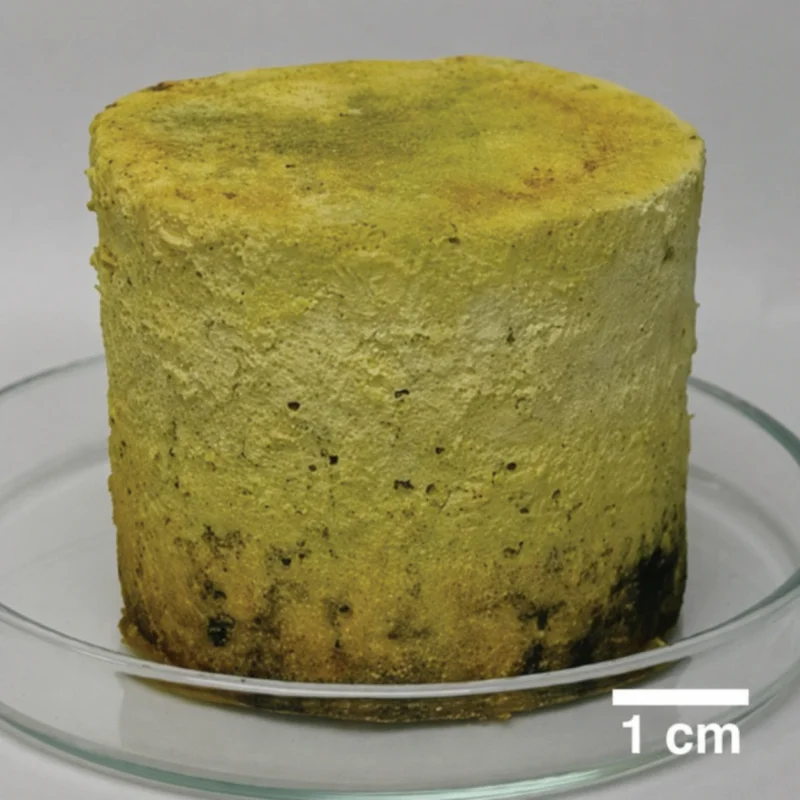
One of my favorite examples is carbon phenolic, a family of ablative composites used when thermal environments are particularly extreme (see Figure 1). Carbon-phenolic systems have protected spacecraft entering planetary atmospheres and lined rocket nozzles exposed to extraordinarily hot, fast-moving gases. The recipe is deceptively simple: carbon fiber reinforcement and a phenolic resin. The interesting part is what happens when you shoot it through the atmosphere and expose it to temperatures beyond 2000 °C. Intuition says that a good heat shield should be a material that doesn't change when it gets hot; carbon phenolic is the opposite.
As the composite heats up, the phenolic resin begins to pyrolyze: instead of simply melting, these materials chemically decompose into gases and a porous, carbon-rich solid residue as shown in Figure 2. The hot gases move outward through the increasingly porous material, carrying heat with them. What remains is a carbonaceous char with extremely low conductivity, helping to insulate the material underneath. Under even more severe conditions, the outermost material is progressively oxidized, eroded, or otherwise ablated.
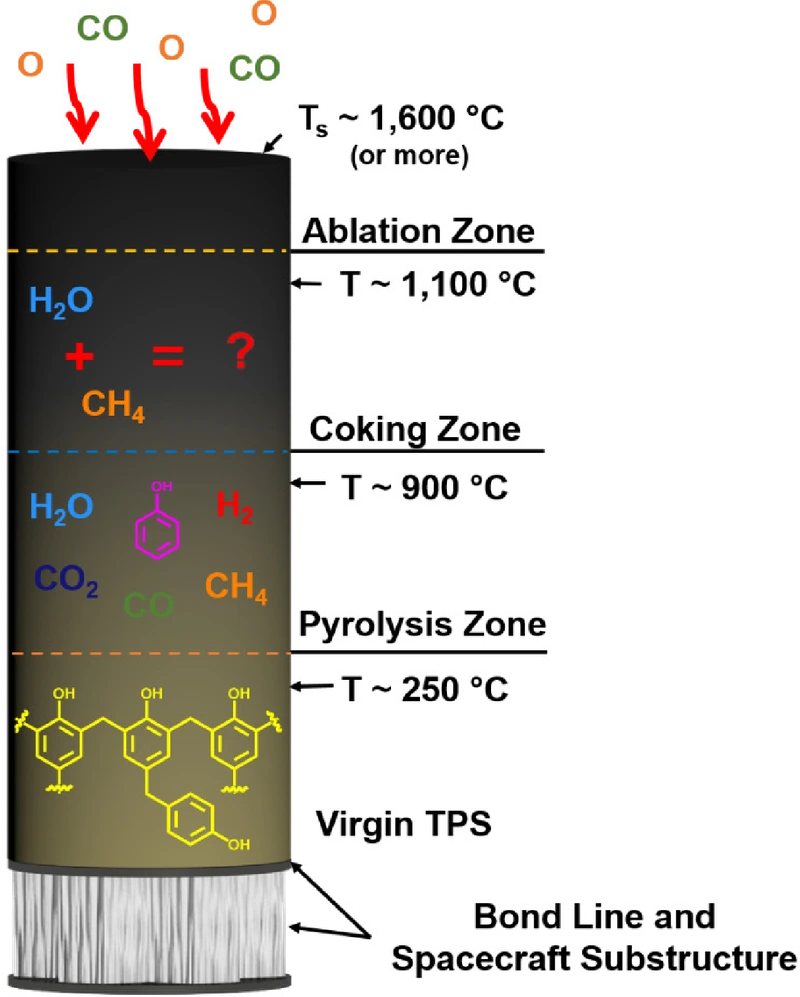
The result is a material that, in a loose sense, cools itself by destroying itself. What we call “carbon phenolic” is therefore not one static material. It is a continuously evolving thermal, chemical, mechanical, and transport system.
That is already remarkable, but it gets more interesting. Just knowing that something contains carbon fiber and phenolic resin tells you very little about how it will behave. Fiber architecture, orientation and packing matter. Resin content, porosity, infiltration, and cure conditions matter. In a woven system, even the subtle geometry of the weave becomes a design variable. The material is engineered not only through chemistry, but through geometry and manufacturing.
In other words, manufacturing is not merely how we make the material. Manufacturing is part of what the material is. This makes these materials notoriously difficult to develop. Changing a small processing step may change porosity, which changes permeability, which changes how pyrolysis gases move through the material. That alters heat transfer and the rate of pyrolysis, ultimately changing how the material performs. A change that looks small in the manufacturing process can propagate through several coupled physical mechanisms before appearing as a completely different material response.
And this is why the usual picture of materials modeling breaks down. At the atomic scale, techniques such as density functional theory (DFT) can tell us enormously useful things about bonding, energetics, and chemical reactions. But an atomistic model does not tell us how a manufactured, woven, porous, imperfect centimeter-scale composite will behave after a particular cure cycle. At the other end of the scale, sophisticated multiphysics simulations can model many of these processes, but those models do not eliminate the need for experiments. They heavily depend on experimentally determined decomposition kinetics, thermal properties, permeability, mechanical behavior, surface chemistry, and a host of other constitutive information; they must then be validated against the real material.
Materials science advances through fabrication, characterization, testing, failure, iteration, and a great deal of accumulated empirical knowledge. And this creates a surprisingly difficult problem for AI: Suppose two papers both report a property for “carbon phenolic.” Are they describing the same material? A materials scientist's answer is “perhaps.” The specimens may use different fiber precursors; and even if they were identical when they entered the test, the reported property may depend on temperature, pressure, or test history. A number attached to the words “carbon phenolic” is not a property of a well-defined thing.
For advanced materials, the limiting problem is not model scale, but representation. A model cannot recover distinctions that have already been erased from the data presented to it. If physically different materials are collapsed under the same name, or the same material is fragmented across different terminology, a larger model does not make the underlying design space coherent. Instead, experimental observations have to be framed around the material state that actually produced them and the conditions under which they were measured. For a material like carbon phenolic, that state includes not only composition, but processing, architecture, structure, and history. Even more, the state itself can evolve during use: In carbon phenolic, even the answer to “what material is this?” changes with time and position inside the material system.
This is why we find advanced materials so fascinating, and why we believe they are an important frontier for AI. There is an enormous amount of knowledge already embedded in a century of experiments, papers, manufacturing records, and failed ideas. But using that knowledge requires understanding what was actually made, what was actually done to it, and under what conditions a particular observation became true. Carbon phenolic is a dramatic example, but the principle is general. An advanced material is not simply a substance with impressive properties. It is an engineered system whose behavior emerges from its composition, structure, processing, environment, and history.